"The world is not a rectilinear world, it is a curvilinear world. The heavenly bodies go in a curve because that is the
natural way..."

-- George Bernard Shaw

"I am not attracted to straight angles or to the straight line, hard and inflexible, created by man. I am attracted to free-flowing, sensual curves. The curves that I find in the mountains of my country, in the sinuousness of its rivers, in the waves of the ocean, and on the body of the beloved woman. Curves make up the entire Universe, the curved Universe of Einstein."

-- Oscar Niemeyer

Monday, 6 April 2015

28. Bangkok: Hotel or Art Gallery?


Mural by Lisa Mam and Peap Tarr
(photo via Lisa Mam)

Generally speaking, I try to keep this blog distinct from the one in which Heather and I showcase street art from around the world, STREETsmArt (www.streetsmart319.blogspot.com). After all, architecture is architecture and street art is street art. The two are completely different. Or are they?

As I highlighted in an earlier post on this blog (23. The Newest Architecture Feature?), architecture and street art are increasingly converging. Nowhere is this more visible than at Cacha in Bangkok, which we had the pleasure of visiting on a recent swing through Southeast Asia.

A first glance at Cacha suggests you're looking at either some kind of arts building or maybe a boutique hotel. But there aren't any obvious clues as to which. You certainly wouldn't guess that it was once a Chinese shophouse.

                                                                                                                 (Photo via Cacha)
Entering Cacha, the mystery only deepens. Your eyes and brain struggle to take in all of the colourful patterns and images that sweep across this open-concept level.


The task of designing the ground floor was given to two of Cambodia's hottest street artists, Lisa Mam and Peap Tarr. Lisa was Cambodia's first female Khmer street artist, and may well be the world's only dentist/street artist. Here's a detail from one of her pieces in Cacha's lobby/restaurant area:


Peap has his roots in the graffiti culture, but has created his own unique style by synthesizing his two heritages - New Zealand and Cambodian. He says his art "exists in a world where lightness and darkness battle, yet co-exist..." Here's one of his contributions to  Cacha's lobby:


As this mural suggests, elephants are the dominant motif at Cacha:
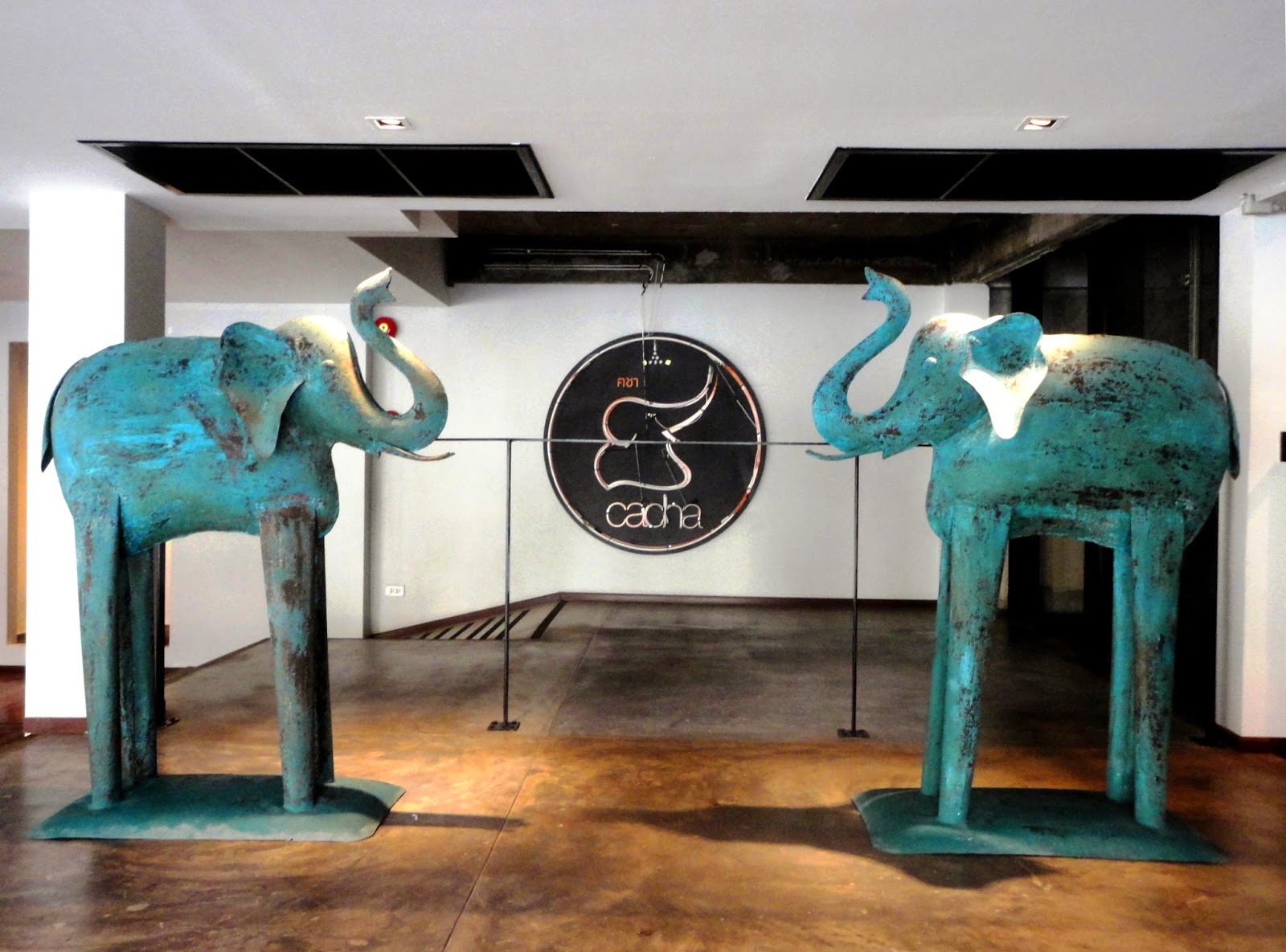

That's not such a big surprise, given that "Cacha" is a poetic Thai word for "elephant".

Still wondering what Cacha is? The answer lies above the first floor floor. There, you'll find comfortable and colourful overnight rooms for paying guests. The rooms feature bold, modern and somewhat edgy murals created by a highly acclaimed five-artist collective called Death of Black (DOB).

If you find yourself headed to Bangkok, you might consider booking a few nights at - to use its full name - the Cacha Art Hotel. You could end up sharing a room with a masterwork by the likes of:

New York graffiti star CHIP7:


Thai illustrator and street artist P7:


Or Thai illustrator and graphic designer, Rukkit:

(last three photos via Cacha)

While you're at it, get used to seeing street art in many more places than just construction hoarding, abandoned buildings, dark alleys and modern art galleries. It is, after all, the fastest-growing art movement in the history of the world! 

And if you'd like to learn more about street art, please check out our other blog: www.streetsmart319.blogspot.com

Saturday, 7 March 2015

27. The Qutb Minar: Delhi's First WOWchitecture

When I first set eyes on Delhi's Qutb Minar about three years ago, it was like peering back into a millenium of Indian history.


Construction of the tower's first and largest storey began in 1193 - a time when it didn't take hours to wend your way through Delhi's traffic-choked streets to reach the site. By the time it topped out in 1368, the Minar stood as the tallest all-brick tower in the world. If that doesn't amaze you, consider this: it still is!


The Qutb Minar was built as a giant political and architectural exclamation point. It symbolized the conquest of the last Hindu kingdom in Delhi by Qutbu'd-din Aibak, soon to become the first Sultan of India. And it proclaimed the beginning of Muslim rule on the subcontinent.

The five-section sandstone and marble Minar - which is in considerably better shape for its age than I am for mine - is a masterpiece of Moghul construction. Here's the "tale of the tape", as they say in the world of pugilism. It rises to a height of 72.5-metres or 238 ft. It has a diameter of more than 14-metres at the bottom and tapers to just 2.75-metres at the top.

Climbing the Minar requires going up 379 steps. But don't worry about your knees - the powers that be haven't let anyone climb it since 1981 when an electric outage blacked out the stairwell and the subsequent stampede killed 45 people.

The Minar's beautiful red and buff sandstone is ornamented with quotes from the Koran in elegantly flowing Arab calligraphy.


The Qutb Minar is part of a complex of buildings that includes a number of ancient monuments, many in partial or near-total ruin. The Alai  Arwaza is the main entry gate and is decorated with red sandstone, inlaid white marble, Arabic script, and latticed stone screens, all designed by the finest Turkish artisans.


The gate leads to the Qubbat-ul-Islam - the first mosque in India, with construction starting in 1192. To clear land for the mosque, the Muslim invaders enacted an ISIS-like scorched-earth policy, plundering the  27 Hindu and Jain temples that stood on the site. They also used some of the remaining materials to build the mosque. Ironically, this effort to destroy Hinduism resulted in a mosque with Hindu ornamentation. 


Other buildings on the site show off more of the brilliantly carved and densely arrayed sandstone.


Not only is the Qutb Minar complex a treasure trove for history and architecture buffs, it's a veritable goldmine for photographers. Here's what I brought back from the motherload by saving some shooting until just before sunset. 

The Minar silhouetted against a modern airliner:


The setting sun "captured" by one of the mosque's archway ruins:


And the contrasting colours and forms of the ruins and the glowing sunset:

Tuesday, 9 December 2014

26. Seven Buildings that will Rock your World in 2015


About a year ago I wrote a post called "Six Buildings that will Rock your World in 2014." It turned out to be my second-most popular post of the year. Far be it from me to argue with success, so let's do it again for 2015.

Here are the buildings that WOWchitecture believes will have the greatest impact on the global architecture scene in 2015. They're bold, they're daring and they'll carry architecture to new heights - sometimes literally.


The New York Trio


Pyramids had a great run during Egypt's "Let my people go" era. The Mayan's brought them back a millennium or two later and also had good success. But when Britain's Lord Norman Foster built a 62-metre pyramid in Kazakstan (Palace of Peace and Reconciliation), it was derided as an act of folly by a country that just had too much oil money.

Then along came Copenhagen's free-thinking architecture firm, BIG, with a plan to place a 32-storey pyramid in New York. And not just in New York, but on the very visible bank of the Hudson River. Known officially as W57 for its location on 57th Street, the pyramid has also been dubbed "Magic Mountain". And oh what magic architect Bjarke Ingles has conjured up. The white building slants back at a steep angle. It has slit-like terraces cut out of its facade. A huge cutout just off centre allows for a football-field-sized plaza whose greenery visually aligns with that of the Hudson River Park.


Via BIG

Speaking of magic, one project that could certainly use some fairy dust is the World Trade Centre. David Childs and SOM certainly didn't imbue it into WTC1 - a monolithic structure that conveys strength and power at the expense of innovation, aesthetic appeal, and grace. Nor did Foster and Richard Rogers, two brilliant British architects whose WTC tower designs suggest they were on auto pilot. As for Fumihiko Maki's already finished WTC4, the less said, the better.

The one bit of WTC magic is coming courtesy of unconventional, organic  architect Santiago Calatrava. Calatrava - arguably the world's greatest architect without a Pritzker Prize - just happens to hail from my adopted hometown, Valencia. For the WTC he's designed the ultimate Transportation Hub. 

At its core is a giant white oculus - the eye-shaped structure that Calatrava has relied upon successfully in the past. Springing out from the oculus on both sides are long graceful wings. On a sunny day the oculus will open, allowing warming rays to bathe those in the mall below. The net effect is that of a huge graceful bird getting ready to take off.

Via Santiago Calatrava

Sometimes, just by using boxes you can come up with something entirely out-of-the-box. At least you can if you're Swiss architecture firm Herzog and de Meuron, the folks who created the splendid Bird's Nest stadium for the Beijing Olympics. Their latest project, 56 Leonard St. consists of a series of rectangles piled one on top of the other. The materials couldn't be simpler: concrete floors, ceilings and support pillars, with floor-to-ceiling windows giving every owner a priceless - actually, an incredibly expensively - view of the incomparable New York skyline.

Where the genius comes in is in the way Herzog and de Meuron have arranged the rectangles. Sometimes the floor plates are identical and sit evenly on top of each other. Sometimes they're not and they don't. Floors cantilever out over the ones below or beneath the ones above. The jagged edge creates a look unlike any skyscraper in New York. At 57 storeys, 56 Leonard St. may not be one of the taller buildings in New York, but it sure will be one of the more unusual.

Via Herzog and de Meuron

The Flying Saucer

If Jean Nouvel's Abu Dhabi Louvre looks a little familiar, it may be because it appeared in one of my earlier posts, "My 8 Favourite Buildings that Look Like Flying Saucers." A branch of the more famous gallery in Paris, the Abu Dhabi version is part of a massive planned cultural project on Saadiyat Island. IF completed - and that's by no means certain - it will be the largest collection of cultural buildings in the world.

Via Atelier Jean Nouvel

The new Louvre is a dead cert to finish, with opening scheduled for the end of 2015. The next to follow will be Foster's Zayed National Museum, scheduled for completion in 2016, but not likely since they've just chosen a construction company.  Meanwhile Frank Gehry's Guggenheim hasn't even gotten that far yet, and the only constant about Zaha Hadid's Performing Arts Center is that it's constantly being postponed. The building is no longer mentioned on the cultural district's website.

Sure, Let's Save al-Qaeda the Trouble

I don't usually post buildings I don't like. In fact, this may be the first time. But I have to admit that the Maha Nakhon in Bangkok is going to get a lot of "WOWs". The 77-storey glass tower was designed by OMA - home to Starchitect Rem Koolhaas. When finished, it will look like it was hit by a couple of planes and instead of repairing the damage they just put new cladding over the crushed in areas.

Via OMA

Technically, this tower qualifies as WOWchitecture. But in the wake of September 11, I wonder how many people will react like I did and say "Wow, how insensitive! Wow, what a shot at New York! Wow, how inappropriate!" Now, I'm not one of those sensitive types who gets all teary-eyed at the mention of 9/11. Heck, I'm not even American (although I do compete as a member of Beard Team USA - but that's another story). Yet even I'm offended by the design of this building.

China Rising

It's no great secret that when it comes to 100-storey supertalls, China is the global leader - and picking up steam by the day. The bad news is that the emphasis on speed and height is resulting in far too many big, boring, blue-clad glass boxes dotting the country. The good news is that there are exceptions to this rule, like the 128-floor Shanghai Tower, which was on last year's Rock your World list, and the 115-floor Ping An International Finance Centre in Shenzen, which is on this year's.

The Ping An, designed by American-based KPFresembles a giant silver rocket ship. It flares a bit at the bottom creating the impression of rocket fins. Then for most of its body it rises straight up, it's height underscored by vertical lines. Near the top, the futuristic building tapers radically on all sides until it reaches a point. Extending from the point is a long thin spire much like those seen in 1950s science fiction movies. Get ready for blastoff in 2015.

Via KPF

Apparently they can Build a Supertall

Within the architecture community, Seoul is known as a city that loves to announce bold and imaginative skyscrapers, even entire new districts of soaring skyscrapers - and then fails to build them. It seems that anytime someone gets even the faintest thought of designing a skyscraper, it gets announced as if it's a sure thing. Then dawn breaks - the dawn of fiscal reality, technological reality and structural reality, and the projects ends up in the ashcan of architectural history.

The Lotte World Tower will break the pattern. The 123-storey tower is simply too far along (91-stories and counting) not to happen. Like the Ping An, the Seoul Lotte was designed - and elegantly so - by KPF. It too starts off straight, but the tapering begins earlier and proceeds more gradually. Rather than coming to a point, the 555-metre building squares off at the top. If that's where it ended it would look quite weird, but the glass cladding rises beyond the core structure, bringing the building to a more stylish conclusion.

Via KPF
That's my list of the seven buildings that will rock your world in 2015. They'll all be finished (at least on the outside) sometime in the year ahead. If you think you know of any that will get a bigger "WOW", just leave me a note at the bottom of this post and I'll consider adding your suggestion to my list.


Monday, 24 November 2014

25. Barcelona: the Ninth Building

A couple of months ago, I wrote a post called "Barcelona: 8 Wildly Colourful Buildings not by Gaudi." It should have been "Nine Wildly Colourful..." but one building was so unique, so idiosyncratic, so absolutely delightful, that I had to give it it's own spotlight. That building is Casa Comalat:


Casa Comalat displays all of the quintessential characteristics of an Antoni Gaudi building. It has Gaudi's playful colours, parabolic arches, curved lines, wavy tile patterns, oversized windows and balconies, joyful exhuberance - and just about everything that makes a building scream out "GAUDI". There's just one thing. The architect who designed it wasn't Gaudi. It was Salvador Valeri i Pupurull.

Valeri Pupurull was part of the generation of Modernista (Catalan Art Nouveau) young turks who succeeded Gaudi. His work on Casa Comalat took place from 1906-11. While owing much to Gaudi's ground-breaking style, Valeri Pupurull went the Catalan grandmaster one step further by giving the building two different facades!

When you stand outside the front facade on the busy main street Diagonal, what your eyes take in is a relatively sober building made of heavy grey stone. And yet there are hints of a hugely creative mind at work.

Like a magnificent wood and iron front door with an ornamental stone-surround:


beautiful wrought-iron balconies with decorative stone supports:
 

stained-glass windows with double pillared stone-surrounds:


and a harlequin-hat roof made of green glazed tile:


reminiscent of Gaudi's greatest work, Casa Batlo.

The front façade usually draws a small crowd of amateur photographers. When they're finished taking their shots, many just drift further down Diagonal assuming that the rear facade is more of the same. Big mistake. BIG MISTAKE!!!

Because it's only when you go around to the quieter backstreet that you'll see the architect's kaleidoscopic imagination in its full, glorious form. To appreciate the Alice-in-Wonderland hallucinogenic vision that presents itself, you really have to study Casa Comalat's rear facade section-by-section.

The top, with its circular aperture and curved roof is amazing in it's own right, but also provides a sneak preview of what is to come....


....more polychromatic porcelain tiles arranged by ceramicist Luis Bru I Salleles to create organic forms, wooden terraces enclosed by stained-glass windows, green wooden window frames, and brown wooden blinds (seen as somewhat of an affectation at the time).....


Below the terraces, Bru Salleles, already regarded as the top ceramicist in Spain, created panels of tiled mosaics the likes of which Europe had never seen:


Supporting it all are two pairs of twin parabolic arches. The arches also protect more stained-glass windows and green window frames and shutters.
 
 
By now you're probably wondering which version of Valeri Pupurull designed Casa Comalat's interior - the grey, sober, orderly one, or the wild, wavy, polychromatic one? Unfortunately, the building is private - largely housing investment companies - and not open to the public.
 
Fortunately, one of those companies Q-Renta Agencia de Valores, has made some interior shots available. I think they'll quite handily answer your question!