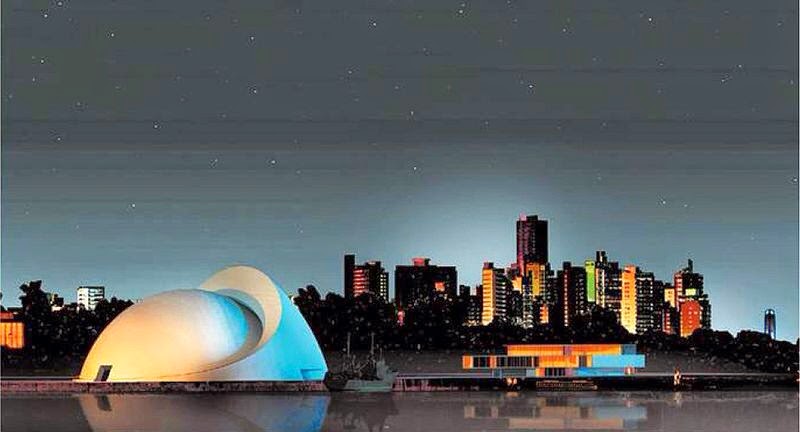
"The world is not a rectilinear world, it is a curvilinear world. The heavenly bodies go in a curve because that is the
natural way..."

-- George Bernard Shaw

"I am not attracted to straight angles or to the straight line, hard and inflexible, created by man. I am attracted to free-flowing, sensual curves. The curves that I find in the mountains of my country, in the sinuousness of its rivers, in the waves of the ocean, and on the body of the beloved woman. Curves make up the entire Universe, the curved Universe of Einstein."

-- Oscar Niemeyer

Saturday, 26 April 2014

14. Seville: The Alcazar + Moorish Architecture

Let's tarry a bit longer in Seville (see my previous post). But instead of focusing on modern architecture, we'll step into our time machine and leap back about 1,300 years.

In 711 AD, the Moors - Islamic Berbers from North Africa - began their conquest of Spain, holding on to at least parts of it for close to 800 years. They were an educated and cultured society with a highly evolved sense of architecture and design. By contrast, the Spanish had a highly evolved sense of destroying Moorish architecture and design - something they did with great relish both during the re-conquest of the country, and for years afterward.

Fortunately, a few surviving architectural gems still testify to the glory that was Moorish Spain. There's the Alhambra Palace in Grenada. The Mezquita (Grand Mosque) in Cordoba. And in Seville, the highly ornamental minaret, the sole surviving part of the Grand Mosque, built from 1184-1198:


Seville is also home to the Torre del Oro (Tower of Gold) a defensive fort built in the early 14th century to ward off Spanish attacks coming from the river:


Most importantly, Seville is the home of the Royal Alcazar (full name: Reales Alcazares de Sevilla) the oldest royal palace still in use in Europe. The Alcazar is considered to be one of the finest examples of Mudéjar architecture in the world. 

But what exactly is Mudéjar architecture you might well ask? Here's my understanding. During the Moorish occupation, their highly skilled artisans would build a magnificent structure on some particular spot. Later the Spanish would destroy it. Then, after the re-conquest, the Spanish would decide that they wanted to build something on the same spot. Recalling the grandeur of the Moorish years, they would hire Muslim architects to build a Moorish-style building. In subsequent centuries the Spanish would add incongruent Renaissance, Romanesque and Gothic elements in a resulting mish-mash.
                                                                                                      
This was, essentially, the story of the Alcazar. It was built as a Moorish fortress-palace in the early eighth century.... or ninth century....or tenth century - no two books or articles seem to agree on the same year. In 1364, after the re-conquest of Moorish Seville by Christians, King Pedro I commissioned the construction of a new palace on the site. Moorish craftsmen from across Andalusia erected a magnificent building arranged around a number of courtyards and patios. Subsequent Christian monarchs expanded the palace in a variety of architectural styles.

The ceremonial entryway to the Alcazar is through the Lion's Gate:


Most paying customers, though, go around the corner, and walk through a massive stone archway:


 which leads to the Moorish facade created for King Pedro I:


Behind the facade is the first beautiful piece of WOWchitecture you come to, the Courtyard of the Maidens. It's surrounded by walls tiled and stuccoed with geometric patterns, and palm-shaped archways:


The courtyard includes a sunken garden divided in two by a rectangular reflecting pool:


The effect is so magical and dreamlike that the courtyard could  have come straight out of a movie. In fact, it's the exact opposite - it was used in a movie, Ridley Scott's Kingdom of Heaven.

The courtyard leads to a number of chambers, the most important of which is the Hall of the Ambassadors, where the old kings received foreign dignitaries. The Hall is entered through a spectacular archway:


which, in turn, houses more spectacular archways:


with the showpiece being a gilded domed roof, built in 1389 (or 1427), highlighted by an eye-dazzling constellation of stars:


Most of the remainder of the Alcazar interior is made up of chambers and chambers-within chambers:


Tiles are everywhere, with the Moorish-inspired artwork:


looking considerably different from the Christian-designed artwork:


Equally appealing - and at times as eclectic and jarring - are the many types of gardens and terraces that surround the Alcazar: Arabic, French. Italian etc. My favourite is the tiled Persian Garden of the Dance:


although I don't think it's been done any favours by the Baroque-ish wall behind it. Others will prefer this garden with squared-off hedges and blossoming trees:


Still others will go for the gigantic date palms:


Just one final point about Mudéjar architecture, and I didn't want to mention it earlier for fear of confusing you even more than I already have. In the late 19th century, there was a bit of a revival of this style of architecture. It was called neo-Mudéjar and the finest example I know of is this building erected in Seville for the 1929 Ibero-American Exposition:


You wouldn't have any trouble persuading Heather and I to live there!
 
PLEASE NOTE THAT MANY OF MY DIGITAL ART PHOTOS (THE REALLY COLOURFUL ONES LIKE AT THE VERY BEGINNING OF THIS BLOG) ARE NOW AVAILABLE FOR PURCHASE AT:

http://www.zazzle.com/wowchitecture* AND
http://seymour-kanowitch.fineartamerica.com

Friday, 11 April 2014

13. Seville, Spain: The Giant Mushroom Building

A couple of weeks ago, my partner Heather and I climbed aboard one of Spain's many high-speed trains and zoomed down to Seville - our first trip to southern Spain. Seville is well-known for it's Moorish architecture, dating back to the 1200's, as well as the largest gothic church in the world. Depending on whose story you believe, Christopher Columbus may or may not be buried there.
 
It's also home to one of the strangest modern architecture sights you'll ever see. It's the largest wooden structure in the world, and is known officially as the Metropol Parasol. The locals call it Las Setas - the wild mushrooms - for reasons that are kind of obvious:


Back in 1990, the city of Seville decided to build a market and underground parking in the heart of downtown. It was a sure-fire cash cow. But in the midst of construction - and after €14 million had been spent - workers discovered ruins dating back to Roman times. Construction was frozen. Later, in 2004, the city decided to develop the area again, and held an international competition.

The competition was won by little-known German architect Jurgen Mayer-Hermann. Various delays ensued and by the time Las Setas were completed in 2011, the estimated cost of the project was €100-million. Much is made of the wooden structure's status as the largest in the world, and the fact that it's held together by glue. Less often is it mentioned that the base is concrete, the inside granite, and the waffle-like roof also held together by a zillion steel bolts.

The Metropol Parasol now houses a museum, market, restaurant, bar and mushroom-themed gift shop. At 26 metres (85 feet) high, 150 metres (490 feet) long and 70 metres (230 feet) wide, it makes an impressive site, by day:

 
And by night:


And if your lucky enough to see it set against an angry sky, you may get a photo like this:


But the best thing about Las Setas is that for a small fee of €3.00 (which includes an alcoholic drink) you can take the elevator up to the roof. There you can walk around a meandering open-air promenade and get a full 360-degree view of Seville from its best viewpoint.


You can see iconic structures, like the old Moorish minaret on the left:


The white-housed neighbourhoods set against the aforementioned angry sky:


Check out one of the neighbour's gardens:


Or go for one of those artsy-fartsy shots where the city is framed by the Setas' :


In addition to being a great place to watch a sunset, the Metro Parasol serves another practical purpose. As its name suggests, it provides a great deal of shade under its billowing rooftop. That's a priceless commodity in a city where summertime highs have been known to reach 52 degrees Celsius!

The sultry heat and comforting shade can make for a romantic atmosphere. Check out these two geezers:


Hey! Who you calling geezers? That's Heather on the left and me on the right. Only our bodies are aging. Our hearts and spirits are as young as ever.


Wednesday, 2 April 2014

12. Five Greatest Arts Centres Never Built

The life of a successful architect must be an extremely satisfying one. How else to explain why so many Pritzker Prize-winners live so long and work so late into their careers. The great Oscar Niemeyer died just 10 days shy of his 105th birthday, still an active architect. Ditto for Philip Johnson who made it to 98 and Frank Lloyd Wright, 91. Still going strong are I.M. Pei, 96, and Frank Gehry, 85, not to mention "kids" Richard Rogers, 80, Richard Meier, 79 and Norman Foster 78.

To achieve longevity - either in life or career - an architect must learn to cope with a good deal of frustration and rejection. In my last post, I presented what I considered to be the "10 Greatest Skyscrapers Never Built". Staying in that vein, I'd like to now focus on the "Five Greatest Arts Centres Never Built".

 When Oscar Niemeyer died on December 5, 2012 the world lost a giant. The Brazilian was not just an architect, but also a visionary, humanitarian and social progressive. His work was like a gift from an alien society to a more primitive race. I can't think of anything that better portrays the gulf between the mostly banal world that we live in and the exciting one Niemeyer foresaw, than this rendering of his Puerto de la Musica proposed for Rosario, Argentina:


via estate of Oscar Niemeyer

Niemeyer's proposed cultural complex would have been part concert hall, part exhibition centre and part music school. The project was launched in 2008 with completion set for 2010 - the bicentennial of Argentina's liberation from Spain - and later pushed back to 2012. In the meantime, political and legal hurdles arose, and then another of Argentina's many recurrent economic crises. Fundraising ceased as Niemeyer's reach exceeded his planet's grasp.

The Atlanta Symphony Centre would have been classic Santiago Calatrava: a white sculptural building with an elongated, arcing roof-piece of lattice-like steel; and moveable wings that opened and closed on either side:

via Santiago Calatrava

When the project was unveiled in 2005, municipal officials boasted of a future impact along the lines of the Sydney Opera House. Unfortunately, private fundraising stalled in 2007 and various levels of government failed to deliver on promised dollars. Seven years later, the four-acre site remains undeveloped.

 Will Alsop's building, The Cloud, was the kind of design, which, along with his general physique, earned him the nickname Mr. Blobby. The Cloud, a 10-storey orb, was to be the centrepiece of Liverpool's revitalization for its year as European Capital of Culture in 2008:

via Will Alsop

Municipal officials hailed Alsop's work as symbolic of a new Liverpool. But the public didn't warm to it and bombarded newspapers with angry letters. As the building's budget grew, the nature of the project changed to include more housing to underwrite the cost of the cultural component. Doubts began to emerge about whether the Cloud would even be ready for Liverpool's big year. Eventually, the plug was pulled, which is why you've probably never heard of Liverpool's year as European Capital of Culture.

 You'd think that a city that craves constant global attention, and an architect whose work virtually guarantees it, would make a perfect pairing. Yet Zaha Hadid's Dancing Towers (see my previous post) never managed to soft-shoe their way onto the Dubai skyline, and neither did her Dubai Opera House.

via Zaha Hadid Architects


The opera house was to have been set on its own island. It's fluid curves and rising peaks swooping down from sky to sea were designed to represent Dubai's sand dunes. Announced in 2006, the opera house sang its swan song during the fiscal crisis when its developer killed off all projects not already under construction. Adding insult to injury, Dubai recently announced that an opera house will be built in a different part of the city by a different architect. It too claims that the new opera house will have the same impact as Sydney's iconic one. Having seen the initial renders, I'd have to say that the hype in Dubai soars even higher than its skyscrapers.

The Guggenheim family has contributed to the world of art and architecture in so many ways. There's the Solomon R. Guggenheim Museum designed by Frank Lloyd Wright for New York City; Frank Gehry's transformational Bilbao Guggenheim in Spain, and the Peggy R. Guggenheim Museum in Venice.

 
Then there was the ill-fated Guadalajara Guggenheim, proposed in an international competition by Asymptote Architects. Their vision imagined the museum as an undulating ceramic and glass mass rising from a plateau over a spectacular canyon:

Via Asymptote Architecture

The first shoe dropped when Asymptote lost the competition to Mexican architect Enrique Norten and his TEN Arquitectos firm. The project was then killed off in 2008 when the estimated cost soared to $300-million, while the Mexican consortium behind it had raised just four million. The Guggenheim Foundation refused to scale down the project to meet the country's arts budget, noting that it only sponsored architecturally significant institutes.

So there you have it - the Five Greatest Arts Centres Never Built. Some people argue that, in times of great economic difficulty, the Arts are a frill or should only be paid for by the rich. This ignores the strong connection between the Arts and economic growth. Where would Bilbao be without the Guggenheim? Sydney without its Opera House? Paris without the Louvre? New York and London without their great theatres? The fact is, we live in a world that needs an even greater investment in cultural WOWchitecture, not a smaller one.

Sunday, 16 March 2014

11. Ten Greatest Skyscrapers Never Built

The world is full of spectacular skyscrapers. Well, maybe not "full of", but at least "dotted with". The Burj Khalifa, Shanghai World Financial Centre, Taipei 101, Petronas Towers, Chrysler Building, Shard, John Hancock Center -- the list goes on and on.
 
Ironically, some of the greatest buildings ever designed have never made it off the drawing board. They flamed brightly but briefly in the minds of great architects. Then they were squelched into the ground by economic downturns, developer bankruptcies, small-minded municipal officials and city councils, government corruption and a variety of other causes.

But let's, for a moment, contemplate what our world might look like today if the following works of WOWchitecture had been built:
 
Norman Foster's India Tower in Mumbai would have been part sculpture, part hotel and fully spectacular:


via Foster and Associates
 
It would have been a silver quiver pointed to the stars. The tower would have risen 2,356-feet or 126-storeys into the sky, giving Mumbai a prominent place on the world architectural map. And it would have given India something more modern to put on its tourist brochures than a 360-year-old kitschy Moghul love monument. But it was not meant to be. Construction began in 2010, was put on hold in 2011, and killed off for good in 2013 due to the hotel chain's financial problems.
 
What Foster couldn't do for Mumbai, he also couldn't do for Moscow. Russia Tower, a 134-storey, $2-billion, rocket-shaped building, never made it to lift-off:
 
via Foster and Associates
 
Russia Tower was supposed to be the focal point of a brand new hub of skyscrapers in Moscow's business district. A cornerstone was laid in 2007, but a couple of years later it became a victim of the global recession. The remainder of the business hub is currently nearing completion.
 
Despite being virtually unknown outside the world of architecture (because much of his career was spent under the SOM brand), Adrian Smith is, in my opinion, the greatest designer of skyscrapers who ever lived. He designed the "world's tallest building" the Burj Khalifa; the future world's tallest, the Kingdom Tower in Saudi Arabia; Chicago's Trump Tower; and a large proportion of the few decent-looking skyscrapers in China.

Despite these credentials, Smith has seen his share of buildings die on the drawing board. Like Dubai 1, a complex of three futuristic skyscrapers, connected by a series of glass sky bridges and entered by via a canal:

via AS + GG

And the Dancing Dragons, once planned for Seoul, South Korea:


via AS + GG
 
My favourite part of this project was the overlapping glass panels that provided the illusion of scale-like skin. Alas, everyone knows that there are no dragons in today's world. Not the flying kind. Not the built kind.

If dragons can't dance, then neither can buildings. Even if you're Zaha Hadid trying to add some whimsy to the Dubai skyline:

Via Zaha Hadid Architects
 
The Dancing Towers, three animated and fluidly flowing buildings unveiled in 2006, we're supposed to be at the heart of Dubai's business bay development. A hole was dug, management changed hands, the hole was filled in, and by 2012 the three dancers were deader than Fred Astaire, Gene Kelly and Ginger Rogers.
 
I must admit, I'd never heard of American architect John Portman until I came across his magnificent 151-storey Incheon Tower planned for South Korea:


via John Portman
 
The 2,000-foot colossus was supposed to be the focal point for a 2,000-acre $17-billion residential, office and hotel complex. It was scheduled for completion in 2010, then 2011 and finally downsized to 101 stories for 2014. But South Korea, where great architectural dreams go to die, has now buried another one.

In contrast to Portman, I've long been familiar with the work of Santiago Calatrava. His BCE Place atrium is one of the architectural gems of my birthplace and long-time hometown, Toronto. His greatest work - a complex of futuristic building called the City of Arts an Sciences - sits on proud display in my new hometown and Calatrava's birthplace, Valencia, Spain.

Calatrava tried to add a little of his futuristic fairy dust to New York in the form of 80 South Street:

 
via Santiago Calatrava

The building was to consist of 12 four-storey cubes, each cube for sale to an individual owner. The cubes we're put on the market starting at $US 29-million, with the top cube costing $US 59-million. When none of the cubes sold and the real estate market went bust in 2008, the project was cancelled.

Most architects these days like to lend an element of green to their buildings. For Mad Architects' Yangson Ma, the green element is the building. His 90-storey Urban Forest, proposed for the city of Chongqing, was basically a high-rise public park with glassed-in mixed use spaces. Critics compared it to a giant stack of plates. But I liked to think of it as an over-sized Dagwood sandwich with too much lettuce:

via MAD Architects

Unfortunately for Ma, the project was cancelled when Chongqing's top official was imprisoned.

The next project on my list doesn't involve skyscrapers, but I just had to include something by bad-boy British architect, Will Alsop. While I'm sure they don't keep statistics on this kind of thing, Alsop may hold the record for the highest percentage of structures designed but not built. His use of brilliant colour and avant-garde forms are too much for most folk, though I'm, clearly not one of them.


Alsop's design for revitalizing the waterfront in the British town of Middlesbrough was at the leading edge of not only architecture but environmental sustainability as well. It would have been the largest zero-carbon development in the UK. Unfortunately, the development firm was killed off by its parent company and Alsop's baby was thrown out along with the bath water.

Finally we come back to Calatrava, whose 150-storey, 2,000-ft. leviathan in  Chicago - the Spire - was to be the tallest building in the Western Hemisphere:
 
via Santiago Calatrava
 
A sizeable round hole was dug on the Chicago riverfront for the spiralling white tower. Then, in 2008, the global economic crisis struck and Chicago was hit particularly hard. The Irish developer behind the project, Kelleher, went bankrupt, leaving the building owing tens of millions of dollars, and no one in the Windy City willing to pick up the ball.
 
Today, the Spire is the classic example of Zombie Architecture - not exactly alive but not exactly dead either. Another development firm has tentatively struck a deal with Kelleher and key creditors. The agreement would resolve the company’s bankruptcy, pay outstanding claims in full and theoretically enable the behemoth project to move forward. The deal won't be fully worked out until late summer at the earliest. Meanwhile the cost of construction, once estimated at $1.5-billion, grows larger by the day. Personally I think this zombie is going to take a bullet to the head before it staggers much more forward.
  There, that's my list of the Ten Greatest Skyscrapers Never Built. You may not agree with all of them, but I hope you'll acknowledge that our world would be a more dynamic and exciting place if at least some of them had seen the light of day.

Now it's your turn. Can you think of any great skyscrapers that I've left off the list? If so please click on the word "comments" at the end of this post and give me your suggestions. I'll give serious consideration to revising the list based on your recommendations.