"The world is not a rectilinear world, it is a curvilinear world. The heavenly bodies go in a curve because that is the
natural way..."

-- George Bernard Shaw

"I am not attracted to straight angles or to the straight line, hard and inflexible, created by man. I am attracted to free-flowing, sensual curves. The curves that I find in the mountains of my country, in the sinuousness of its rivers, in the waves of the ocean, and on the body of the beloved woman. Curves make up the entire Universe, the curved Universe of Einstein."

-- Oscar Niemeyer

Monday, 24 November 2014

25. Barcelona: the Ninth Building

A couple of months ago, I wrote a post called "Barcelona: 8 Wildly Colourful Buildings not by Gaudi." It should have been "Nine Wildly Colourful..." but one building was so unique, so idiosyncratic, so absolutely delightful, that I had to give it it's own spotlight. That building is Casa Comalat:


Casa Comalat displays all of the quintessential characteristics of an Antoni Gaudi building. It has Gaudi's playful colours, parabolic arches, curved lines, wavy tile patterns, oversized windows and balconies, joyful exhuberance - and just about everything that makes a building scream out "GAUDI". There's just one thing. The architect who designed it wasn't Gaudi. It was Salvador Valeri i Pupurull.

Valeri Pupurull was part of the generation of Modernista (Catalan Art Nouveau) young turks who succeeded Gaudi. His work on Casa Comalat took place from 1906-11. While owing much to Gaudi's ground-breaking style, Valeri Pupurull went the Catalan grandmaster one step further by giving the building two different facades!

When you stand outside the front facade on the busy main street Diagonal, what your eyes take in is a relatively sober building made of heavy grey stone. And yet there are hints of a hugely creative mind at work.

Like a magnificent wood and iron front door with an ornamental stone-surround:


beautiful wrought-iron balconies with decorative stone supports:
 

stained-glass windows with double pillared stone-surrounds:


and a harlequin-hat roof made of green glazed tile:


reminiscent of Gaudi's greatest work, Casa Batlo.

The front façade usually draws a small crowd of amateur photographers. When they're finished taking their shots, many just drift further down Diagonal assuming that the rear facade is more of the same. Big mistake. BIG MISTAKE!!!

Because it's only when you go around to the quieter backstreet that you'll see the architect's kaleidoscopic imagination in its full, glorious form. To appreciate the Alice-in-Wonderland hallucinogenic vision that presents itself, you really have to study Casa Comalat's rear facade section-by-section.

The top, with its circular aperture and curved roof is amazing in it's own right, but also provides a sneak preview of what is to come....


....more polychromatic porcelain tiles arranged by ceramicist Luis Bru I Salleles to create organic forms, wooden terraces enclosed by stained-glass windows, green wooden window frames, and brown wooden blinds (seen as somewhat of an affectation at the time).....


Below the terraces, Bru Salleles, already regarded as the top ceramicist in Spain, created panels of tiled mosaics the likes of which Europe had never seen:


Supporting it all are two pairs of twin parabolic arches. The arches also protect more stained-glass windows and green window frames and shutters.
 
 
By now you're probably wondering which version of Valeri Pupurull designed Casa Comalat's interior - the grey, sober, orderly one, or the wild, wavy, polychromatic one? Unfortunately, the building is private - largely housing investment companies - and not open to the public.
 
Fortunately, one of those companies Q-Renta Agencia de Valores, has made some interior shots available. I think they'll quite handily answer your question!


Friday, 7 November 2014

24. Eclectic Architecture at its Best 

It's been a while since I last showcased a building in my adopted hometown of Valencia. Let me remedy this right away lest you think we Valencianos are WOWchitecture-challenged.

One of my favourite places in the city for building-watching (sort of like people-watching, but the buildings don't care how long you stare) is the Plaza del Ayuntamiento or Town Hall Square. The square is named after this rather Baroque-looking building, scene of many a football celebration and political protest:


  In case you're wondering, that's a football celebration. So is this:


Really. They don't call this city's biggest festival Las Fallas (The Fires) for nothing.

 
At the heart of the square (which, this being Europe, is actually triangular) is a cascading fountain that serves as a focal point for many a photo-op:


More recently, an artificially chilled skating rink has been added - a rather expensive act of folly that allows Valencianos to pretend for a couple of months that it actually gets cold around Christmas. Never mind that daytime highs are usually in the 18-20 C. range.

The square itself is surrounded by leafy plane trees and stately palms. It's also dotted with kiosks selling herbs, orchids and fresh-cut flowers. Circling the square (or should that be triangulating the triangle) are elegant buildings in a variety of architectural styles, largely erected in the first third of the 20th century. This was, of course, before Franco and his jack-booted storm troopers stomped all over the heart of socialist Spain.

 This blending of architectural styles often results in an ugly urban mish-mash, but in Valencia's case it actually works. The harmonious assembly of structures includes curved and pricey Art Nouveau apartment buildings:


  An Art Deco movie theatre:


Moorish-inspired low-rise buildings:


  And other interesting buildings just trying to fit in:


My favourite building on the square is the Central Post Office by  Miguel Angel Navarro and architect to whom I cannot attribute a single other building. Its architectural style has been described as "truly eclectic" and that, if anything, is an understatement.

The exterior is a melange of Moorish-style cupolas, six Baroque winged figures, a 30-foot high Art Deco-ish metallic replica of a once-functioning communications tower - and that's just on the roof:


The main entry facade showcases architectural Classicism in the form of four gigantic Ionic columns. A smaller set of six columns supports a platform on which sit five figures representing the continents and symbolizing international communications.

And yet, the real WOW factor doesn't even present itself until you enter the building. There, you are welcomed by two naked golden goddesses, each carrying two lamps in their hands and balancing one on their heads, as well as by a richly carved wooden ceiling, and wood-trimmed windows - all done in the Art Nouveau style:


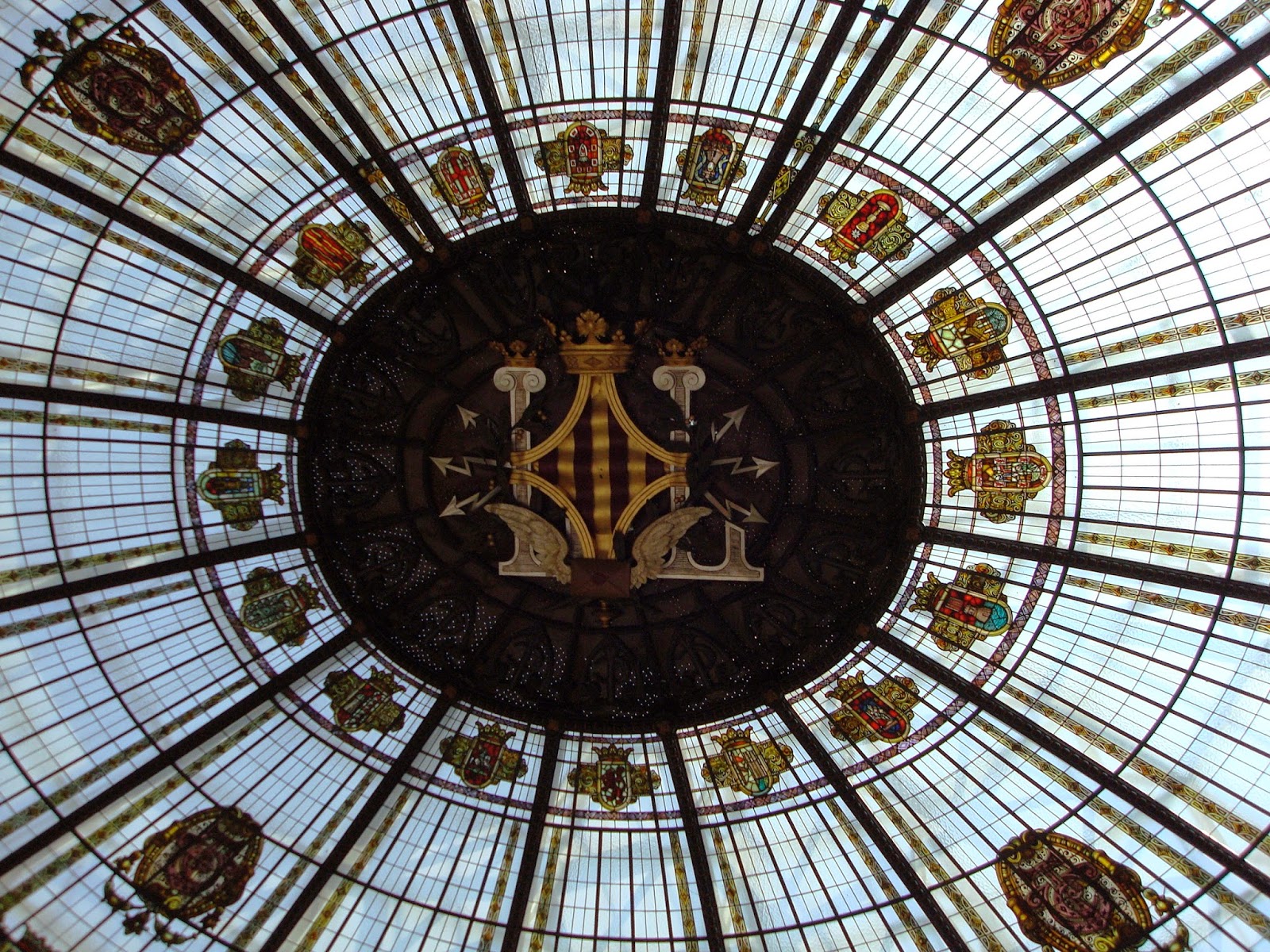
Walk through to the Main Hall, an elliptical space where the city's postal business is still being transacted on a daily basis. Look up, and you'll see an exceptional domed-ceiling featuring 3,500 pieces of stained glass:


The Valencia Central Post Office is, in short, a microcosm of the many architectural motifs that make up the Plaza del Ayuntamiento. The Plaza, in turn, is a microcosm of the city's diversity of built form.

If you want to walk around 700+ years of architectural history - starting with the 14th century gates and bridges to the city and finishing with the futuristic City of Arts and Sciences - you'd be well served by a visit to my adopted hometown.

Who knows, you might even want to move here. I know Heather and I did!

Saturday, 1 November 2014


We hope you will visit and enjoy this site for as long as you like. We also hope you'll consider looking at our new blog:  http://streetsmart319.blogspot.com We think you'll like it.

Saturday, 11 October 2014


23. The Newest Architectural Feature?

The discipline of architecture doesn't, technically speaking, include street art. Or colloquially speaking. Or any way of speaking, for that matter. And yet, neighbourhoods and even individual buildings are increasingly being judged by their street art.

Of course, many neighbourhoods, homes and buildings are perfectly beautiful the way they were built. You wouldn't, for example, want to further adorn the Burj Khalifa, Chrysler Building or Petronas Towers. 

But if you happen to be the owner of a relatively modern, but somewhat banal building, street art can add a distinct dash of splash:

Apartment in Valencia, Spain. Artist: Julieta.

Apartment in Gdansk Poland.
 photo via mrpilgrim.co.uk
A little street art here and there can be the first step in renewing an impoverished area and boosting neighbourhood pride:
Apartment in working-class Barcelona district.

Building in gentrifying Valencia neighbourhood. Artist: Ericailcane.
And it won't even cost cash-strapped governments a nickel. In some cases, landlords commission the work; in others, artists (not exactly wealthy themselves) pick up the tab for materials and contribute their time. In a better world, community funding would underwrite both craftsman and supplies.

That may not be as direct as tackling the root causes of poverty, but you have to start somewhere. Besides street art can act as a community revenue stream, flowing tourists dollars to local stores, galleries and restaurants; and attracting investment dollars with which to create better facilities.

Street art can do big things, like promoting a country's cultural identity:


Dancer on the outside wall of a Valencia Flamenco restaurant.
Artist: Paloma Cort

Or small things, like offering up a bit of humour to someone having a bad day:

 Gentrifying Valencia Neighbourhood.
Artist: Luis Montolio
As Banksy once said, “Graffiti is one of the few tools you have if you have almost nothing. And even if you don't come up with a picture to cure world poverty you can make someone smile while they're having a piss.” 
Now let's be truthful, not all street art is beautiful or attractive. Just because some idiot knows how to buy a can of spray paint and write his name on a wall doesn't make it art, or make him Picasso.

By the same token though, I can take you into just about any art gallery in the world and show you paintings worth millions that I wouldn't hang on my bathroom door. Yes, I'm talking about you Barnet Newman and your $1.8 million con job on the National Gallery of Canada, in Ottawa:

Voice of Fire

Now, don't get me wrong. I like modern art as much as the next guy. In fact, probably more than the next guy. Van Gogh, Kandinsky, Dali, Warhol they're my main men. When I see a masterpiece by one of them I get positively stoked. (Wait a minute, I'm 62-years-old - I gotta stop talking like that!)

But let's face it, if you could only look at one piece of art for the rest of your life, which would you choose? This one by Mark Rothko:

Or this one by Julieta:


To me it's a no brainer.