"The world is not a rectilinear world, it is a curvilinear world. The heavenly bodies go in a curve because that is the
natural way..."

-- George Bernard Shaw

"I am not attracted to straight angles or to the straight line, hard and inflexible, created by man. I am attracted to free-flowing, sensual curves. The curves that I find in the mountains of my country, in the sinuousness of its rivers, in the waves of the ocean, and on the body of the beloved woman. Curves make up the entire Universe, the curved Universe of Einstein."

-- Oscar Niemeyer

Sunday, 10 April 2016

40. Zaha Hadid: An Appreciation

 New Century City Art Centre, Chengdu, China
(All renderings via ZHA)

Architects aren't supposed to die at 65. They really aren't. From Sinan Mimar the builder of Istanbul's great mosques (who died in 1588 aged 99) to Oscar Niemeyer who created the magical jungle city of Brasilia (and lived to within 10 days of his 105th birthday) architects have been renowned for living long, fulfilling and productive lives. Let's also not forget Philip Johnson, who reached 98, Frank Lloyd Wright 91, Jorn Utzon (Sydney Opera House) 91 and Buckminster Fuller 87.

Among the living and still going strong are I.M. Pei, who will turn 99 later this month, Cesar Pelli 91 and Frank Gehry 87.

Finding an architect who died at 65 or younger took me all the way back to the Finnish duo of Eero Saarinen (St. Louis Gateway Arch) and Viljo Revell (Toronto City Hall). The former died while undergoing surgery for a brain tumour in 1951, aged 51. The latter in 1964 aged 54.

Then came Thursday March 31, and the shock heard round the architectural world. The news, when it arrived, was swift and stark, bare and brutal: Zaha Hadid, Dead at 65. Like a nuclear explosion it arrived unexpectedly, unmercifully, and with soul-crushing finality. Like a thief in the night it robbed us of an invaluable treasure, one we are helpless to replace. We had expected so much more from her -- like at least another couple of decades of transformational work, lifting the bar higher and higher to worlds unimagined -- and unimaginable by other architects.

We are, by now, familiar with the broad brushstrokes that shaped her life's work: a woman in a "man's profession"; an Iraqi Arab in a world dominated by the West; a new face in England, a country often more comfortable with Empire than immigration; and a prodigious mind that designed structures that were often deemed too spectacular to bring to life -- even in envelope-pushing Emirate Dubai:

Signature Towers 

Dubai Opera House

Where others might have been blinded by the glare of the public spotlight, or crushed by the weight of expectations, Hadid shone. The greater the challenge, the more she rose to it. To the Pritzker Prize -- often referred to as the Nobel Prize or Academy Award of the architecture profession -- the first woman to do so. To two consecutive RIBA Stirling Prizes. To a multitude of other awards and accolades too numerous to mention.

Dame Zaha Mohammad Hadid, DBE to give her her full due, was a complex and multi-talented person who always chose the road not taken. She didn't understand words and phrases like "normal", "ordinary", "status quo", "fitting in", or "running with the crowd". Her buildings, like her personality, were outrageous, audacious, flamboyant, singular, provocative and iconoclastic. She simply set out to create a new type of architecture, and she succeeded marvelously. She didn't work outside of the box, she destroyed the box completely.

We live in a world today which, unfortunately, privileges brevity over profundity. Thoughts, even paradigm-changing ones, are expected to be expressible in 120 characters or less. And so, many have sought to encapsulate Hadid's work in a single word: organic, futuristic, visionary, curvy, swervy, free-form, undulating. Each on its own is inadequate; all together, they still come up short.

If I were to accept the fool's errand of summing up Hadid's work in a single word, that word, as self-serving as it may be, would be WOWchitecture. There simply wasn't a single thing that she created -- buildings, bridges, pavilions, artwork, furniture, jewelry, even yachts....to name a few -- that didn't make you go WOW! She was the ultimate WOWchitect and on most days my favourite.

Hadid-designed Yacht

Those of us who were fans of her hyperimaginative style, each had our favourite buildings. Her best-known structure was the white concrete and glass (nearly all of her buildings were white concrete and glass) London Aquatics Centre built for the 2012 Olympics. Hadid called it "a concept inspired by the smooth geometry of water in motion":


For me, her creme de la creme included the Heydar Aliyev Center in Baku, Azerbaijan:
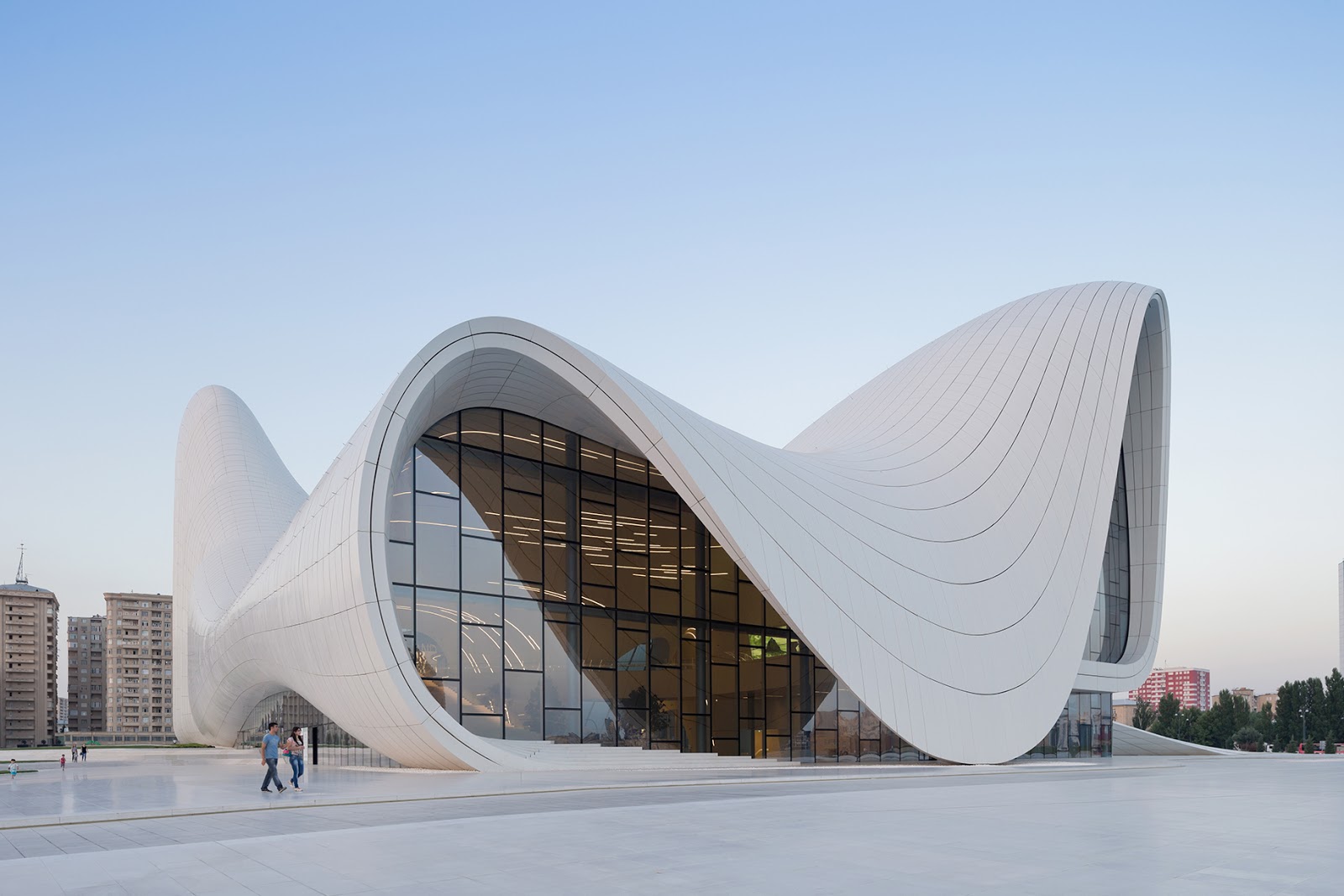

Guanzhou Opera House:


Wanjing Soho:


  Regium Waterfront:


These are already built. Others are underway and will soon join the parade of spectacular structures. Like the metro station at the King Abdullah Financial District in Riyadh, Saudi Arabia:


And Port House in Antwerp:


Somewhat further down the road, we should see the construction of the Sleuk Rith Institute, a memorial in Phnom Penh to Cambodia's holocaust:


Unfortunately, there is still a great deal of uncertainty as to whether her greatest design will ever see the light of day -- an Abu Dhabi arts centre so bold and futuristic that it can only be compared to the Starship Enterprise:


While her creations may have been close to perfect, Hadid herself had her share of flaws. Frailties are, regrettably, part of the human condition. Some of hers were small ones. She could, for example, be prickly. A reporter arriving for an interview could never be certain as to which version of the lady would show up. Then again, the same has been said of Gehry.

She could be flush with the arrogance of success, but not as badly as Lloyd Wright, who designed his first wife's clothes so that they wouldn't clash with the house they lived in. She didn't suffer criticism well -- who amongst us does -- to the point where she denied the obvious. She bristled when her design for the Al Wakrah stadium in Qatar was criticized for resembling a woman's private parts. And yet I would defy any reasonably intelligent person to look at a rendering of the stadium and deny that what they are seeing is anything other than:


A GIANT VAGINA!!!
  
Small sins are forgivable. But she committed large ones as well. Like embracing dictatorships: in Libya...in Azerbaijan...in Russia...in China...in China again...and again...and again... Seeing her designs built always seemed more important to her than promoting human rights. She argued (never persuasively) that good architecture could help open up closed societies. She could also be dismissive about the deaths of low-paid, immigrant construction workers in the countries where she built. She didn't pass up jobs or advocate on their behalf. "It's not my duty as an architect" she proclaimed to The Guardian in a quote that would earn her the enmity of much of the architectural community.

Such are the complexities and dualities of creative genius: brilliance and instability; iconoclasm and arrogance; advocacy and denial; creating new worlds while toadying to the worst values of the old.

At the end of the day -- and sunset arrived much earlier than we had expected -- Zaha Hadid was a woman who knew her own mind, listened to her own heart, set her own path and followed her own dreams. She lived, perhaps unknowingly, the mantra of another brilliant (and flawed) star who shone brightly for a while before flaming out, also too soon, Steve Jobs:

"Time is limited, so don't waste it living someone else's life. Don't be trapped by dogma -- which is living with the results of other people's thinking. Don't let the noise of other's opinions drown out your own inner voice. And, most important, have the courage to follow your own heart and intuition...Everything else is secondary."


Saturday, 26 March 2016

39. The Great Mosque of Córdoba: The Sacred and the Profane (Part II)


Nothing says "mosque" quite like a wooden Jesus on a cross. Or an ostentatiously gold-framed painting of an angel smiting a heathen:


Actually, pretty much everything says "mosque" more than a wooden Jesus or a smiting angel. But when the Spanish Christians recaptured Córdoba from its Muslim occupiers in 1236, the last thing on their minds was preserving the Great Mosque as an Islamic monument.

Still, if there's one thing I've learned about Roman Catholic Church leaders, it's that they have tremendous respect for religion -- as long as it's their own. Anyone else's is fair game for persecution, degradiation, desecration, and a dozen other nasty things brought to you by the same fine folk who would later launch the Spanish Inquisition.


A tip-off as to the architectural rape that the Mosque would endure under the so-called "custodianship" of the Catholic Church, can be found in the official name of the building: the Cathedral of Our Lady of the Assumption. No one actually calls it that, of course, except for the Vatican and the Spanish Church. Your average Cordoban just refers to it as "the Mosque-Cathedral".

The Mosque was re-consecrated as a cathedral after the reconquest, and the DIY crew started in almost immediately. Under muslim rule, the Mosque had been enclosed only on three sides. The fourth, opened out into the Patio de los Naranjos (Patio of Orange Trees). The net effect was two-fold. The orange trees aligned with the Mosque's red and white arches, creating the image of a large forest. And the sun pouring in made the Mosque a very light and open place to be.

When the Catholics took over, they built a fourth wall and sealed the windows, making the cathedral a rather dark and gloomy place, which it still is today. But then the Catholic clergy prefer their flock to be in the dark -- both literally and metaphorically.

The most visible sign of the desecration of the Mosque -- one that can be seen from the other side of the city across the Guadalquivir River -- is a baroque belfry that was built to cover up the former minaret. It serves as a beacon signalling to the world that the Mosque is "Under New Management". Not that it's an ugly belfry. It's actually quite an attractive 16th-century structure:


But -- and this is a crucial point -- MOSQUES DON'T HAVE BELLS!!!

Other crimes against architecture committed by the Church pretty much fit into the same category as the belfry: eye-catching, in a gaudy sort of way, but wholly inappropriate. Perhaps the greatest abomination -- both in an architectural and religious sense -- was the 1523 insertion of a Renaissance cathedral smack dab into the middle of the Gothic mosque. This was, of course, facilitated by first tearing out the heart of the Mosque and then sticking in a very random-looking selection of naves:


chapels:


and altars:


There were, however, some attractive additions like the beautifully crafted mahogany choir stalls, pilfered...err...liberated... from the finest trees that the American rainforests could provide:


And the lovely organ just above the choir's heads:


Both would look splendid in a building of their own era, instead of being thrown in to survive amongst a mish-mash of architectural styles and a handful of ornamental do-dads that would look more at home in a pagan temple than a Catholic Church:


I knew, for example, that eagles were regarded as birds of "prey". But I didn't know that they were also considered birds of "pray".

Adding insult to injury, the Spanish Diocese banned Islamic prayer within the building -- an edict that remains intact to this very day -- despite appeals all the way up to and including the Pope. To make doubly sure that no Islamic prayers were offered, the Muslim Mihrab (prayer niche) and nearby chambers were blocked off by metal fencing. And to make triply sure, the Spanish monarchy, which had so enjoyed turfing out the country's Jews in 1492,  also gave the boot to Spain's Muslims in 1609. 

Still, I wouldn't want to make it sound as if the Muslims were all pure-as-the-driven-snow good guys. There is the story of Al-Mansur, the fearsome warlord who led a bloody raid in the late 10th-century that penetrated as far into Christian territory as Santiago de Compostela. There, he rode his mighty steed into the cathedral and let it drink from the font of holy water, both quenching it's thirst and pissing-off the Catholic Fathers no end. Al-Mansur proceeded to have the Church's bells carried 500 miles southwest to Córdoba where they were melted into lamps for the Great Mosque. But don't expect to see them if you visit Córdoba -- following the re-conquest of the city, the Castillian King Ferdinand III had the lamps carried back to the shrine of St. James, where they were converted into molten form and again shaped into bells.

Let's give the final word on the Mosque-Cathedral to King Carlos V. It was he who gave the final order for the big 1523 renovation/desecration, without ever having been to Córdoba or understanding the impact it would have on one of Islam's greatest monuments. When he finally saw the damage that had been committed by his minions in his name, he is said to have proclaimed, "You have built here what you or anyone else might have built anywhere else, but you have destroyed what was unique in the world."

Thursday, 3 March 2016

38. The Great Mosque of Córdoba: The Sacred and the Profane (Part 1)


   Interior of a Mosque in Cordova by Edwin Lord Weeks                          

As a devout atheist, maybe I shouldn't be tossing around terms like "sacred" and "profane". But I do so in a purely secular sense. To me, the closest thing to "sacred" is a great work of architecture - architecture that is so powerful and spectacular that it rises above everything else created in its time. "Profane", I reserve for actions that destroy or degrade the grandeur, beauty and architectural integrity of a great structure.

The Great Mosque of Córdoba displays both of these elements. In this post I'm going to focus on the "sacred" aspects embedded by its original Moorish builders. In the next, I'll show you the "profanities" inflicted on it by the Catholic Church.

The Moors, largely Muslim Berbers from Morocco, invaded Spain in 711 AD as part of the great Islamic expansion that followed the death of Mohammed in 632. They would occupy parts of the Iberian Peninsula for the next 750+ years. Construction of the Great Mosque of Córdoba began in 784, taking more than 200 years until it reached its current dimensions in 987.

This massive undertaking - a symbol of conquest and empire - required the efforts of thousands of artisans and labourers. As the Mosque grew in size and importance, so too did Córdoba. At its height, it was the most populous city in the world, and the most advanced centre for science, medicine, education, culture and finance.

Given the general temper of the times, the Mosque's powerful outer walls more closely resemble those of a fortress than a house of worship:


A fortress with really powerful, tall bronze doors:


Amazing door knocks:


And large sections of wall with crenelated tops, arched windows adorned with geometric and floral patterns, and red and white decorative stone and tile:


Inside the Mosque it's all pillars. Pillars, pillars and more pillars. Pillars of jasper, pillars of onyx, pillars of marble and pillars of granite - 856 in all - the largest number of pillars in one building in the history of the world. The pillars support red and white arches of just about every style, size and design. Double arches support the Mosque's high roof:


Interlacing arches:


 Polylobed arches:


And special arches denote the space reserved for the Caliph's family:
 

The arches can be a photographer's best friend, offering some nifty ways to frame your shots:


Running the length of the prayer hall are beautifully crafted lamps:


and elsewhere in the Mosque as well:


The most important feature of the Mosque, or, for that matter, any mosque is the mihrab or prayer niche. In the case of this mosque the "niche" is the size of a room, and it's quite magnificent:


Its opening is framed by coloured mosaics made of small pieces of glass (tesserae) that create rich bands of dark blue, reddish brown, yellow and gold:


Guilded Koranic caligraphy crawls around the square frame:


But there's something very unusual about this mihrab. By tradition, mihrabs point toward Mecca and show the faithful in which direction to pray. Mecca is southeast of Cordoba. Yet the Mihrab is aimed due south. Why? Because Damascus is due south.

The Ummayad dynasty, which built the Córdoba mosque, had once ruled in Damascus, then the centre of the Islamic world. They built  the Great Ummayad Mosque - still standing today and largely intact despite the civil war. It is believed that when the Ummayads (involuntarily) relocated to Córdoba, they wanted their new mosque to acknowledge its older Damascene brother as the holiest mosque outside of Mecca.

Almost stealing the Mihrab's thunder is its spectacular shell-shaped dome, carved out of a single piece of marble and lavishly coloured with gold mosaics.


The Great Mosque of Córdoba is truly quite massive. If you're just interested in a cursory look at the major highlights, it will probably take you 1-2 hours to see them. If, like us, you'd like a more thorough and detailed look with some serious time devoted to your photography, you'd better budget a half-day. On the other hand, if you're a total architecture and mosque geek who has to examine every pillar, arch and chamber, there's probably enough to keep you busy for a day-and-a-half - although you'll have to make it back to your hotel for the overnight stay!

But sooner or later you're going to have to leave this great wonder of the  medieval world, and rather than doing it with a heavy heart, let your spirits soar as you walk past the stained-glass windows en route to the exit:


Monday, 18 January 2016

37. Eight Buildings that will Rock Your World in 2016

Pingtan Art Museum, by MAD Architects, image via MAD Architects
 
It's that time of year again, the one that many of us have been eagerly awaiting. Christmas is over, along with its insufferable carols, jingles and commercials. New Year's hangovers have disappeared, as have most New Year resolutions. Post-gorging diets are in high gear, as we atone for seasonal overindulgences.

Far more importantly, it's time for our annual look-ahead to the futuristic, envelope-pushing structures that will rock our world in 2016.


The Falcon Soars


Image via Foster + Associates
 
Lord Norman Foster may be 80, but he continues to show the young Turks how the future will look. This year will see the completion of his Sheikh Zayed National Museum in Abu Dhabi, with a design said to represent the wing tips of a falcon. It's part of the (supposedly) huge Saadiyat Cultural District. I said "supposed" because there are strong rumours that Frank Gehry's Guggenheim will be shelved for a much cheaper military installation; meanwhile there has never been any indication that Zaha Hadid's Performing Arts Centre will move ahead to construction. To date, Jean Nouvel's flying-saucer shaped Louvre is the only cultural project completed. That's what happens in a petro-economy when the price of oil takes a dive. 


The Discs have Landed

Image via Atelier Jean Nouvel

Speaking of Jean Nouvel, the French master builder will see his vision of the Qatar National Museum come to full fruition this year. Sticking with his space vehicle motif, Nouvel has shifted from a single giant flying disc to a couple dozen intersecting smaller ones that look like they've been randomly scattered across the desert floor. The new structure will be built around an existing palace. According to the Qatar Museums Authority, "the tilting interpenetrating disks that define the pavilions’ floors, walls and roofs, clad on the exterior in sand-colored concrete, suggest the bladelike petals of the desert rose, a mineral formation of crystallized sand found in the briny layer just beneath the desert’s surface."


It's Raining Silver

Image via Snohetta

If you were to drop giant molten silver ingots from the sky, what you'd you get - besides a hernia and very burned hands - would be something that looks a lot like the King Abdulaziz Center for World Culture, in Dahran, Saudi Arabia. The facade of the flowing metallic structure, designed by Norwegian company Snohetta, will be made from stainless steel tubes that will be intricately and individually formed and bent, then wrapped around the building. The structure is said to mirror the flowing dunes and sculpted rock formations of the Saudi landscape. The Center will house an auditorium for the performing arts, cinemas, a 200,000 book library, museum, exhibition hall and archive.


From Quarry to Gem

Image via Coop Himmelb(l)au

Put an abandoned Chinese cement quarry in the hands of alchemists like Coop Himmelb(l)au, Austria's most innovative architecture firm, and what you'll get in return is a magical winter gem. The Deep Pit Ice and Snow World will be located in the Dawang Mountain Resort area near the city of Changsha, capital of Hunan province. The project will combine an entertainment Ice World with an indoor ski slope, a water park, restaurant and shopping facilities. 

The complex will consist of two sculpted buildings. The dominant horizontal one will span 170-metres from cliff-to-cliff over a sunken and hanging garden, creating a new leisure space of islands, water, cliffside pathways and ramps connecting the building to the surrounding natural heritage. A cantilevered swimming pool will be part of the water park attractions, with a 60-metre high waterfall dropping into the former quarry pit. A separate sculptural 100-meter tower will host a five-star hotel and will be connected to the Ice World via a grand garden Plaza.


Art Museum or Rorschach Test?

Image via Mad Architects

Ever since Santiago Calatrava and Zaha Hadid created the template for futuristic arts buildings, the formula has been pretty straightforward. The structures have to be white, weird, wavy and sufficiently organic or abstract to lend themselves to the interpretation of the observer. 

Pingtan Art Museumon an island off the coast of China near Taiwan, may reflect these qualities to the extreme. From some perspectives, like the one at the top of this page, it looks like a giant stingray. From others, like the one just above, it resembles a mousepad. Some have compared it to a pile of sand dunes. Whatever your perspective, there's no denying that Yansong Ma's creation will be the largest privately funded art museum in Asia - housing a collection of more than 1,000 Chinese artworks and objects in a 40,000 square-metre structure.


Latin Heat

Image via Fr - EE

The city of Miami continues its transformation from time-worn tourist hub to urbane arts centre. The latest addition to the creative scene will come in a few short months when the Latin American Arts Museum (LAAMopens its doors for the first time.

The building, which will consist of four white platforms, each rotated at a different angle to is central axis, has a touch of Zaha Hadid in its soul. But in reality, it's all the brainchild of Mexican architect Fernando Romero and his company FR - EE. With generous-sized terraces, LAAM will have a fair amount of outdoor garden space and sculptures. The  museum's opening exhibition will feature the work of world-reknowned Colombian artist/sculptor Fernando Botero, signalling its strong intentions to become one of the great Latin American arts centres in the world.


Like a Fine Wine....

Image via Moshe Safdie

...Moshe Safdie just keeps getting better with age. The Israeli-born, Canadian-raised, U.S.-educated architect made his first big international splash with his Habitat building at Montreal's Expo '67. He was, at the time, celebrated as a 29-year-old wunderkind. But Safdie, now 77 has probably done his greatest work since he turned 70. In 2010, his Marina Bay Sands hotel in Singapore - the one with the three 57-storey towers topped by a boat-shaped infinity pool - opened as one of the most stylish and spectacular hotels in the world. The following year, he further adorned the marina area with his equally imaginative Museum of Artscience, whose design is supposed to resemble a lotus flower, but which most people agree resembles a bunch of bananas with the ends cut off. 

Photo by Seymour Kanowitch

Safdie seems to have found new life in Singapore. His next contribution to the city-state, Sky Habitat (a rethinking of his original Habitat?) is preparing to open in just a few months. Sky Habitat will, in fact, consist of two 38-storey residential towers, identically (wedge-) shaped but facing each other in opposing directions. The towers will be connected at three levels. The bottom two bridges above ground will be, essentially, walk-through gardens. The third will connect the buildings at rooftop level and is a more modest version of the infinity pool at Marina Bay Sands. By 2017-18, Safdie will be adding a massive glass dome with gardens and a 40-metre waterfall to Singapore's Changi Airport.


Colombian Colossus

Bogota's BD Bacata, a complex of three towers, is going to be a project of "firsts". The first skyscrapers built in Colombia in 35 years. The first skyscrapers in the world financed by crowdfunding - with $145-million supplied by 3,000 investors. And the tallest of the towers will be the no.1 building in Colombia, with 66 storeys soaring 853-ft high. In two of the the three buildings, the floors will be grouped in rectangles with increasingly wide setbacks as the buildings climb. The project was designed by Barcelona-based Alonso-Balaguer y Arquitectos Asociados. It's worth noting that the firm's design is infinitely superior to a later one created by the much-celebrated BIG architects for World Trade Centre No. 2.


Images via Alonso Balaguer y Architectos Asociados