"The world is not a rectilinear world, it is a curvilinear world. The heavenly bodies go in a curve because that is the
natural way..."

-- George Bernard Shaw

"I am not attracted to straight angles or to the straight line, hard and inflexible, created by man. I am attracted to free-flowing, sensual curves. The curves that I find in the mountains of my country, in the sinuousness of its rivers, in the waves of the ocean, and on the body of the beloved woman. Curves make up the entire Universe, the curved Universe of Einstein."

-- Oscar Niemeyer

Friday, 5 June 2015

30. Getting Lucky in Chiang Mai


Sometimes you're good, sometimes you're lucky. Sometimes you're both, but I don't have much experience in that area. Sometimes you're neither - a situation I'm more familiar with. But if I have to choose between the two, I'll take lucky every time -- even if it's disguised as bad luck as it was on our recent trip to Chiang Mai, Thailand's tourist magnet in the north.

Most visitors to Chang Mai book themselves into a hotel or guest house inside the old city walls. That's where most of the 300 ancient Buddhist temples are. It's also where you'll find the dozens of travel agencies that will book you on the exact same tours as every other travel agency: glide on a river raft; see a waterfall; ride an overworked elephant; visit a hill-tribe village and pose with a colourful-looking native. And it's where you'll find the most pubs, reggae bars, jazz clubs, pizza parlours and Indian restaurants - all those authentic experiences that brought you to Thailand in the first place.

Still, I can't claim complete innocence in this affair. We did, after all, try to book a room inside the old city ourselves. It was just our misfortune that it was during the Christmas-New Year season and everything was booked up.

Or was it misfortune? We ended up booking in for 10 days a few blocks outside the city's northern wall. On our first day there, we shunned the inner city, following our own path outside the wall. In the process, we discovered three amazing temples.Best of all, since the inner-city residents rarely strayed outside the wall for their temple-gazing, we practically had all three to ourselves.

Wat Montein aka the "dragon temple" was built by Laotian monks. It's not particularly old, but it's hard to miss with its very large outdoor Buddha, multi-tiered roof, and gilded front door:


as well as what may be the most lavishly ornamented exterior outside Bangkok's Royal Palace:


Inside, the Wat was no slouch either, with its beautiful Buddha shrine:


Immediately next door was another temple, Wat Kuan Ka Mah, which - for reasons that might be obvious - we referred to as Wat Horsey:


None of the prayer halls or reception rooms were open, but what we saw from the outside was more than impressive:


As it turned out, we had saved the best for last. Across the moat from Wat Montein and Wat Kuan Kah Ma (i.e. even further away from the old city) was Wat Lokmolee. Unlike the other two temples, Wat Lokmolee was genuinely ancient. So ancient, in fact, that no one knew when it had been built. Its name first appeared in historical documents in 1367.

The Wat was a splendid vision both outside:


and in:

 
with the principal Buddha, wooden columns and decorated ceiling being particularly spectacular:
 
 
The temple grounds were full of shrines to a panoply of gods, many of which originated in Hinduism but were later embraced by Buddhism. Like Brahma:
 

Lord Ganesha:
 
 
The Chinese Goddess, Kuan Yin:
 
 
And, of course, those omnipresent denizens of Buddhist temples, the Nagas or serpent deities, shown here in exquisitely carved detail:
 
 
So the moral of the story is, as it usually is for travellers -- as it often is in life -- don't follow the herd; don't run with the pack. Or as the poet, Emerson once said "Do not go where the path may lead, go instead where there is no path and leave a trail." You might just find something more interesting lies there.
 
FOR A VERY DIFFERENT PERSPECTIVE ON CHIANG MAI, PLEASE CHECK OUT OUR OTHER BLOG: http://www.streetsmart319.blogspot.com


Wednesday, 13 May 2015

29. The Most Beautiful Temple in Thailand?


Chances are, you've never heard of the town of Phitsanulok. Odds are even greater that you can't pronounce it's name. And, if you've ever been there, it was probably just to break up the 12-hour train ride from Bangkok to Chiang Mai; or, as a base for exploring the nearby ruins of Sukhothai, one of Thailand's (many) ancient capitals.

That's unfortunate, because Phitsanulok houses several beautiful and important historical sites of its own - not the least of which is the magnificent and sprawling Wat Phra Sri Rattana Mahatat Woramahawihan. And no, I can't say it five times quickly or pronounce it correctly even once. I just do what the locals do and call it Wat Yai (Big Temple). 


Wat Yai was built in 1357, with numerous renovations since. Its most important Buddha figure, the Phra Phuttha Chinnarat (Victorious King) is considered to be the most beautiful in Thailand. It's also regarded as the second-most important, out-venerated only by the emerald Buddha (which is actually made of jade and really small) in Bangkok.


The Buddha's beauty is said to spring from the halo that surrounds its body, radiating holiness.
 The statue was originally cast in bronze but later plated in gold, giving it an extraordinarily bright sheen.

For those who envision Buddhist temples as retreats of near silence and peaceful contemplation, Wat Yai should cure that illusion. Just past the entry to the compound, you'll be confronted by a cacophony of sounds - amplified broadcasts asking for donations, a strip of vendors hawking everything from herbs to temple offerings, lottery tickets and framed posters of the Buddha. 

Past the hubbub is the entrance to the main sanctuary. It was smaller than I had imagined, but extremely ornate:


Inside, the sanctuary proved to be somewhat of a Tardis. The hall was quite deep:


And also high, with pillars and ceiling adorned in gold and lit by crystal chandeliers:


Amazingly, this was just one of a number of sanctuaries dotting the Wat Yai compound. Behind it was another featuring gloriously framed doors and windows:


another imposing Buddha:


and a set of paintings that told the story of King Naresuan the Great who, in the 15th century, personally led his army on elephant back to free central Thailand from Burmese rule:


For me, the most fascinating part of Wat Yai was the cloisters, now serving as a display area for ancient Buddhas:


There were lots and lots of Buddhas:


Big Buddhas:


Small Buddhas:


And just outside the cloisters (probably because he couldn't fit in), this unusually chunky Buddha:


Wat Yai offered many WOW moments, but one thing that really surprised was the way people dressed. Having travelled through many Buddhist countries over the course of 27 years, I was well aware of the advisories, admonitions and strictures requiring  visitors to dress respectfully, i.e. arms and legs covered. Apparently the locals weren't quite so aware. Many wore short-shorts, tank tops, muscle shirts, t-shirts, miniskirts, flip-flops etc. Guess they hadn't read the same guide books.

Monday, 6 April 2015

28. Bangkok: Hotel or Art Gallery?


Mural by Lisa Mam and Peap Tarr
(photo via Lisa Mam)

Generally speaking, I try to keep this blog distinct from the one in which Heather and I showcase street art from around the world, STREETsmArt (www.streetsmart319.blogspot.com). After all, architecture is architecture and street art is street art. The two are completely different. Or are they?

As I highlighted in an earlier post on this blog (23. The Newest Architecture Feature?), architecture and street art are increasingly converging. Nowhere is this more visible than at Cacha in Bangkok, which we had the pleasure of visiting on a recent swing through Southeast Asia.

A first glance at Cacha suggests you're looking at either some kind of arts building or maybe a boutique hotel. But there aren't any obvious clues as to which. You certainly wouldn't guess that it was once a Chinese shophouse.

                                                                                                                 (Photo via Cacha)
Entering Cacha, the mystery only deepens. Your eyes and brain struggle to take in all of the colourful patterns and images that sweep across this open-concept level.


The task of designing the ground floor was given to two of Cambodia's hottest street artists, Lisa Mam and Peap Tarr. Lisa was Cambodia's first female Khmer street artist, and may well be the world's only dentist/street artist. Here's a detail from one of her pieces in Cacha's lobby/restaurant area:


Peap has his roots in the graffiti culture, but has created his own unique style by synthesizing his two heritages - New Zealand and Cambodian. He says his art "exists in a world where lightness and darkness battle, yet co-exist..." Here's one of his contributions to  Cacha's lobby:


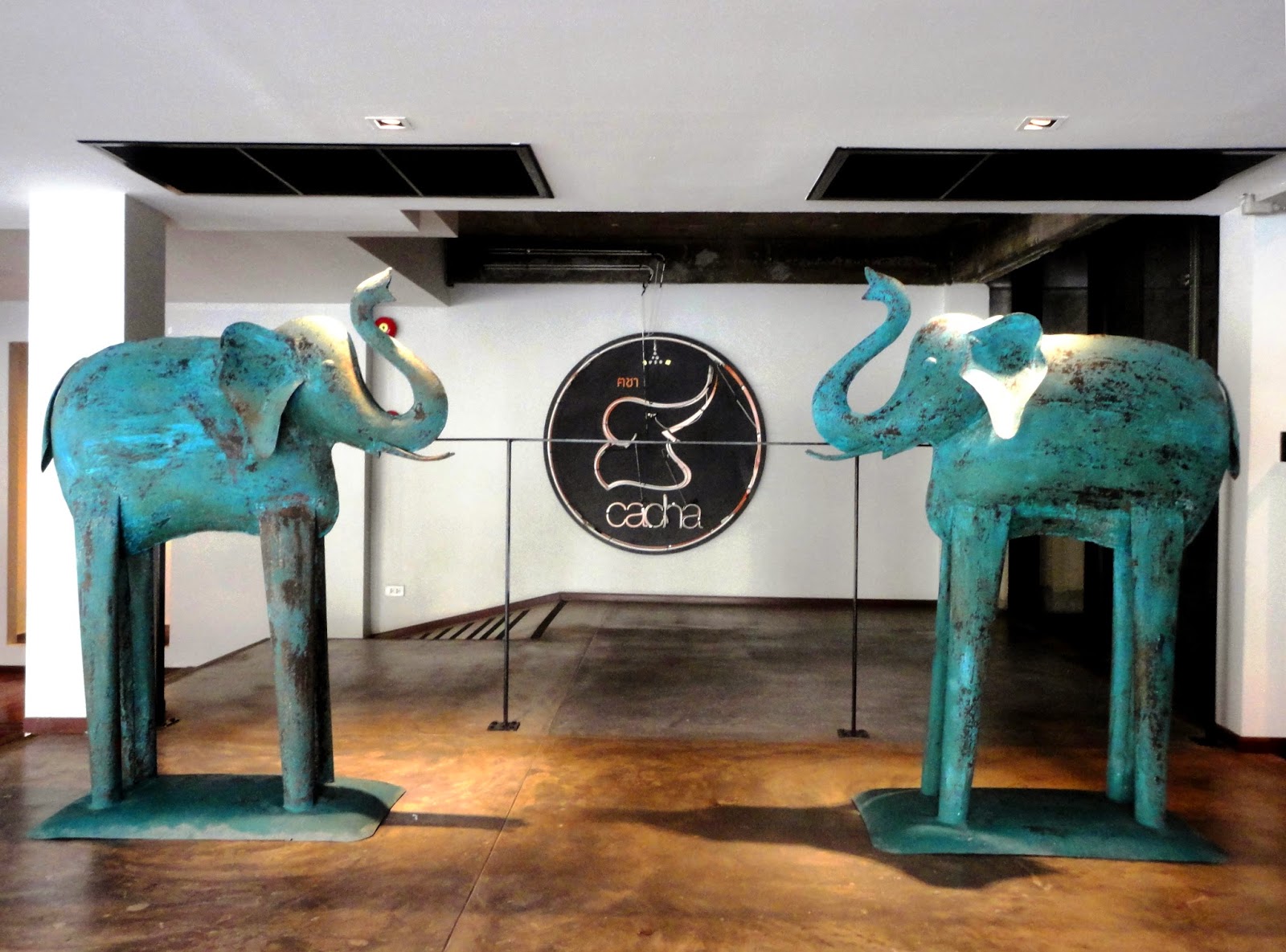
As this mural suggests, elephants are the dominant motif at Cacha:


That's not such a big surprise, given that "Cacha" is a poetic Thai word for "elephant".

Still wondering what Cacha is? The answer lies above the first floor floor. There, you'll find comfortable and colourful overnight rooms for paying guests. The rooms feature bold, modern and somewhat edgy murals created by a highly acclaimed five-artist collective called Death of Black (DOB).

If you find yourself headed to Bangkok, you might consider booking a few nights at - to use its full name - the Cacha Art Hotel. You could end up sharing a room with a masterwork by the likes of:

New York graffiti star CHIP7:


Thai illustrator and street artist P7:


Or Thai illustrator and graphic designer, Rukkit:

(last three photos via Cacha)

While you're at it, get used to seeing street art in many more places than just construction hoarding, abandoned buildings, dark alleys and modern art galleries. It is, after all, the fastest-growing art movement in the history of the world! 

And if you'd like to learn more about street art, please check out our other blog: www.streetsmart319.blogspot.com

Saturday, 7 March 2015

27. The Qutb Minar: Delhi's First WOWchitecture

When I first set eyes on Delhi's Qutb Minar about three years ago, it was like peering back into a millenium of Indian history.


Construction of the tower's first and largest storey began in 1193 - a time when it didn't take hours to wend your way through Delhi's traffic-choked streets to reach the site. By the time it topped out in 1368, the Minar stood as the tallest all-brick tower in the world. If that doesn't amaze you, consider this: it still is!


The Qutb Minar was built as a giant political and architectural exclamation point. It symbolized the conquest of the last Hindu kingdom in Delhi by Qutbu'd-din Aibak, soon to become the first Sultan of India. And it proclaimed the beginning of Muslim rule on the subcontinent.

The five-section sandstone and marble Minar - which is in considerably better shape for its age than I am for mine - is a masterpiece of Moghul construction. Here's the "tale of the tape", as they say in the world of pugilism. It rises to a height of 72.5-metres or 238 ft. It has a diameter of more than 14-metres at the bottom and tapers to just 2.75-metres at the top.

Climbing the Minar requires going up 379 steps. But don't worry about your knees - the powers that be haven't let anyone climb it since 1981 when an electric outage blacked out the stairwell and the subsequent stampede killed 45 people.

The Minar's beautiful red and buff sandstone is ornamented with quotes from the Koran in elegantly flowing Arab calligraphy.


The Qutb Minar is part of a complex of buildings that includes a number of ancient monuments, many in partial or near-total ruin. The Alai  Arwaza is the main entry gate and is decorated with red sandstone, inlaid white marble, Arabic script, and latticed stone screens, all designed by the finest Turkish artisans.


The gate leads to the Qubbat-ul-Islam - the first mosque in India, with construction starting in 1192. To clear land for the mosque, the Muslim invaders enacted an ISIS-like scorched-earth policy, plundering the  27 Hindu and Jain temples that stood on the site. They also used some of the remaining materials to build the mosque. Ironically, this effort to destroy Hinduism resulted in a mosque with Hindu ornamentation. 


Other buildings on the site show off more of the brilliantly carved and densely arrayed sandstone.


Not only is the Qutb Minar complex a treasure trove for history and architecture buffs, it's a veritable goldmine for photographers. Here's what I brought back from the motherload by saving some shooting until just before sunset. 

The Minar silhouetted against a modern airliner:


The setting sun "captured" by one of the mosque's archway ruins:


And the contrasting colours and forms of the ruins and the glowing sunset: